(The Moral Calculus of Picking) The Game of the Year
I've been trying to get my thoughts on my favorite games this year in order, and in so doing I have been thinking about how tricky it is to have favorites at all in these days of decrepitude. While I think everyone gets to draw the line on what they'll put up with to continue to enjoy something innately enjoyable, I'd be remiss if I didn't cop to spending a lot of time wrestling with the ethics of consuming art produced by fallible people under the conditions of late-stage capitalism.
The adage about there being no ethical consumption under capitalism is a good one because it's a reminder that you can only act as morally as the system you exist within allows you to. Since we're talking specifically here about videogames, I'll point out that all technology relies on the brutal exploitation of both people and the environment to exist. We can find ways to mitigate that, but at the end of the day, every time I fire up my gaming console, I'm part of the same process as a kid digging raw materials out of a hole in the middle of a jungle somewhere; as a factory worker without adequate respiratory protection spraying hexane on a motherboard; as the developer whose contract is cancelled so their parent company can add a fraction of a fraction of a percent to the year-over-year profits at the next shareholder meeting.
But what am I going to do, not play videogames? Well, I'm not going to play some videogames, is where I landed on this one, which is probably a good place to start talking about Microsoft. Microsoft is one of the biggest companies in the world and includes a gaming division, which is a relatively small arm on this corporate octopus, but an arm that has been having some very public problems lately. We're not going to go into many specifics except that this division has been pursuing a strategy of acquiring a lot of game developers for the past decade or so, all while their hardware division has been losing market share, so they are under some pressure to turn things around. Meanwhile, the parent company has also been busy developing advanced tech products which they've sold to a lot of questionable actors, including the government and military of Israel.
This led to public protests by employees against this partnership with Israel, which resulted in multiple retaliatory firings, as well as a call from BDS to boycott Microsoft, in particular their gaming division, Xbox, and its game subscription service, Game Pass. So I cancelled Game Pass and stopped buying games made by Microsoft. The problem is, if we look back a paragraph in this post, we will recall that MS has been hoovering up studios for years, which means there are a lot of small developers who only want to make a fun videogame for people to buy, but supporting their work weakens the boycott, which has had at least a little success so far. Which is why I have such a hard time recommending one of my favorite games of last year, South of Midnight, which I do not think you should buy.
South of Midnight feels like a throwback to a game of 15-20 years ago, featuring linear level design, a few fun mechanics, and an enchanting story told through charmingly animated cutscenes as well as some toe-tapping tunes that unfold in unexpected and profoundly moving ways. It's one of the best experiences I had playing a game last year, and if it weren't for being published by Microsoft I would be yelling screaming jumping up and down at everyone I met to play it. It uses some interesting templates (The Wizard of Oz as well as Black Southern folklore) to tell a fairly straightforward story about a young girl learning to use the magical gifts that are her birthright. It's not a game that lends itself to being described, as the sum of the parts are less than the whole. I wish we lived in a world where we got one of these type of games every year, but given how little I heard this one discussed, I'm not holding my breath.
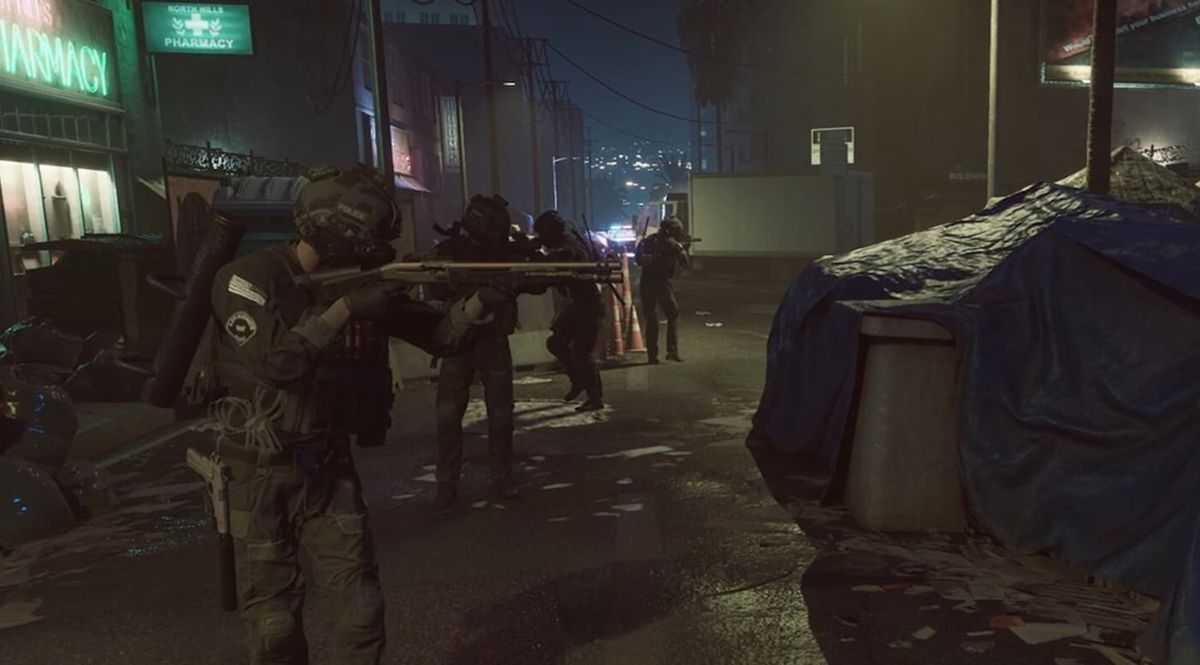
The other game I felt severely morally compromised by last year is Ready or Not, a squad-based tactical shooter in which you play one of a team of SWAT-style police soldiers out to restore order to a barely-disguised Los Angeles stand-in, replete with wandering unhoused drug addicts, trigger-happy gang members, and politically-motivated terrorists. It is pure copaganda, in which every person you come across on the map has to be restrained for their protection and getting a good ranking means not shooting too many people with the military grade armaments you're kitted out with, but using "less lethal" munitions on suspects who don't surrender fast enough. The game is wholly indefensible, but I think about playing it constantly.
I would say the majority of my socializing takes place online these days. I still go out and see people pretty regularly, but I've probably spent more hours in game chat with my friends over the past 5 years than I have in the company of actual human beings I don't live with. Part of that was the pandemic, but it also speaks to the quality of the online gaming experience, and while what we like to play waxes and wanes, it turns out that several of us really like to spend our time virtually clearing out an apartment building full of cryptocurrency miners who are protected by assault rifle-carrying, ethnically ambiguous gang goons.
I think it helps that there is a layer of unreality to the game. Unlike war games like Call of Duty or other tactical shooters, Ready or Not doesn't feature real world locations or licensed weaponry. There's something more troubling to me about the idea of Remington or Glock getting countless hours of advertising from soldier and cop sims than the sort of goofy half-assedness on display when we boot up a map in this game, but that might be a cope. The truth is that I enjoy solving tactical problems with flashbangs and pepperballs, and while I think the kind of fantasy Ready or Not depicts is potentially socially harmful, I choose to think it's less harmful in this particular case. Is that a cope?
I think it might be a cope.