Man of Constant Sorrow
There's a sequence in the Frank Oz-directed Hollywood satire Bowfinger that I think about a lot, especially in relation to Christopher Nolan movies. In Bowfinger, Eddie Murphy co-stars as an absurd and paranoid action film star named Kit Ramsey, who is the unwitting star of sleazy producer Bobby Bowfinger's (Steve Martin) guerrilla sci-fi film, Chubby Rain. The denouement of said film-within-a-film is to be a scene in which the aliens chase Ramsey, aided by a mysterious blonde (Heather Graham in a very mean but very funny send-up of Martin's ex, Anne Heche) to the top of Griffith Observatory so he can yell a catchphrase at the appropriate time. During the long car chase and running through the observatory, Graham explains in a goofy non-denominational European accent the complex events of the script to a bewildered Murphy, whose paranoid character nods along and seems to absorb the borderline nonsensical babble. As they make their way through the observatory, they encounter an auditorium full of people wearing 3D glasses and staring up, presumably at the type of classic rock-soundtracked laser light shows that were popular at the time. Murphy stops, confused about what they're doing, and Graham, dropping the accent entirely deadpans, "They're all aliens worshipping their false gods," which gets Murphy moving again instantly.
This nicely parallels a scene near the end of my favorite Nolan film, Inception, in which Elliot Page's character, Ariadne, has to explain at a clip to Leonardo DiCaprio what he's supposed to do to complete the intricate dream heist at the heart of the film. This occurs while they are careening down a mountain pursued by machine gunning skiers and follows so many contrivances and complications that deciphering the specifics of what's happening would require at least a standalone newsletter if not a small tome devoted to the mechanics of the plot. The genius of Nolan is that he knows to put this summary explanation of the action here, mid-chase, so that when we get to the film's real climax, we only require a series of wordless images to understand what happened and what's happening, at least to the extent we need to understand it to enjoy the film.
The excitement I felt at the prospect of a Nolan adaptation of The Odyssey was largely based on how much I love his love of spectacle and set-pieces and imagining his adaptive maneuvers with the rich, well-known material of the ancient narrative. I am also generally onboard for anything that pisses off racists and those obsessed with upholding tradition for tradition's sake, so I was greatly looking forward to the 7am IMAX 70mm screening I bought tickets to weeks ago. The short version is that I don't think Nolan's Odyssey is a bad film, or a particularly bad adaptation, but there's a lot of stuff I liked less than I expected to. I think that's important to get out of the way before I get into specifics, since although I don't believe you can spoil a 3000+ year-old story, there's specific choices he makes that I'll be talking about, and if you haven't seen it and want to without my snarky voice in your head calling out stuff I found goofy, this is probably a good place to pause and come back after your viewing. This is what I did with Emily Wilson's excellent pan of the film in the London Review of Books, which I've only read about half of because it's very long and I wanted to order my thoughts before fully absorbing hers.
Anyway, from here on I'm going to talk about things in the film itself, so you are forewarned.
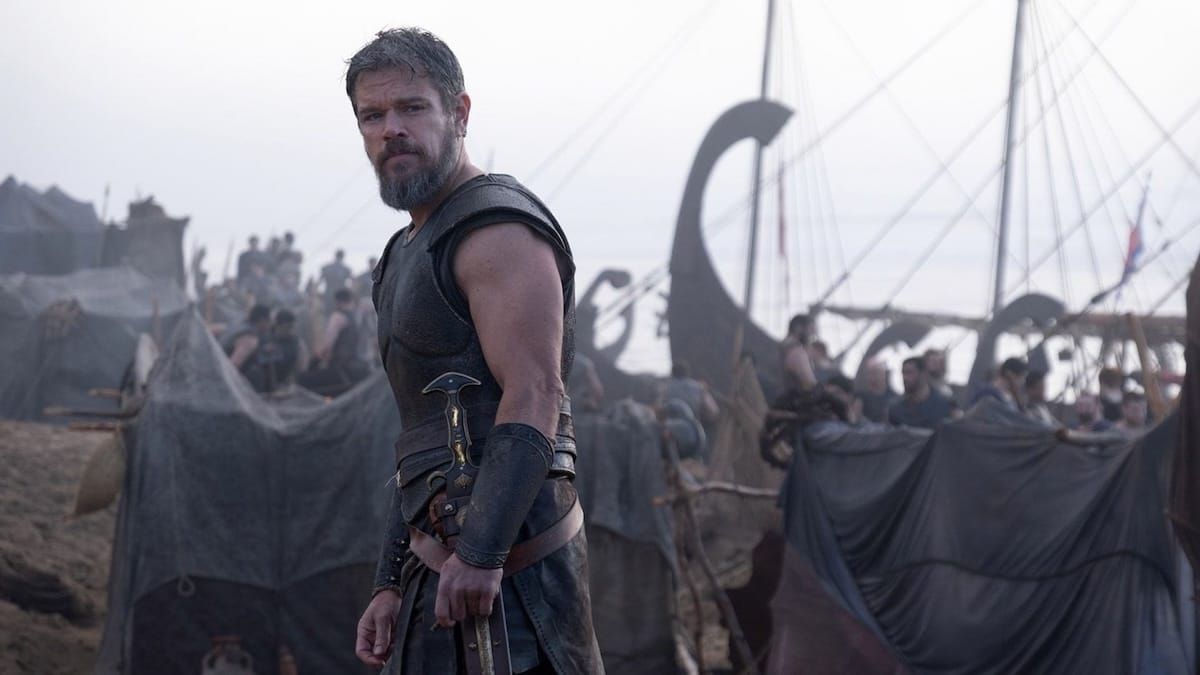
First up, I think a lot of the casting is good, and what isn't good is basically okay. There's no huge misfires, and most of the blah performances are down to the lack of stuff the actors are given to do or things edited out. Charlize Theron is a good example here, as her Calypso just is a nothing character, with no evident motivation or purpose beyond looking pretty and feeding a scraggly Matt Damon fresh caught fish and amnesia-inducing lotus flowers. Even the revelation that he's been idling on her beach for seven years barely elicits more than a shrug from both of them. This is made a narrative issue as Nolan chooses to cut back to them from the first moments of the film throughout most of the rest of its 3 hour run time, and although the cutting back isn't excessive, it feels unnecessary given the paucity of what's happening onscreen.
The best casting in the film is almost unquestionably John Leguizamo as Odysseus's faithful blind swineherd, who serves as an advisor and explicator to Tom Holland's Telemachus as well as the audience. You don't put John Leguizamo in a small but important role in your film unless you want him to crush it, and Nolan understands and uses that to maximum advantage. I also think Matt Damon in the lead role is fairly good at delivering what is needed from him. I'll get into my issues with how this plays out a few paragraphs from now, but I don't think that reflects badly on his work here in a part that is demanding on his physical body as well as his knowledge of the craft of film acting. There are a lot of super close-ups projected five stories high, so you need to be able to decipher his thoughts without taking psychic damage from a stray cocked eyebrow. The last performance I want to highlight is Samantha Morton as Circe*, who is phenomenal. This interlude, like many of the others, is given short shrift in the film, but she really makes it sing for her time onscreen, and I would happily watch the premium cable spin-off miniseries about her.
Circe's island also offers us a good chance to pivot to the look of the film, since it's one of the better looking segments therein. Odysseus's ship rows near the island and observes its lone building up high on a hill, puts ashore, and separates the leader from his men, building tension by having them encounter fearsome-looking beasts that seem docile and melancholy, like creatures in an underfunded zoo enclosure that has skimped on enrichment tools. The men go to Circe's hut, where her seeming hospitality turns to horror as they scarf down her food. Eventually Odysseus comes to their rescue, and we get a good look at the pig/man transformation process, which is gross, fascinating, and incredibly effective. A+ stuff all around.
Like most of the acting, most of the movie looks fine, with some exceptionally good stuff. I don't love the look of a couple of the monsters because they feel like an overcorrection from the Ray Harryhausen style of stop motion creature effects. They're serviceable, and do the job of not taking me out of the movie, but I didn't swoon over Nolan's Polyphemus (who doesn't get name-checked), or his Scylla (who does). The best looking (and sounding) bit of the film is when the sailors consult the dead in a black and barren plain. One more acting shout-out here for Elliot Page, who gets a total of about 5 minutes of screen time and sells every second of them. He's stoic and sad and vulnerable in perfect balance and his admonition of Odysseus is the most understandable and damning the film feels of its hero's actions. Put a pin in that, because I'm finally going to come around to it after I spend a paragraph blasting the film's finale.
Everyone I was with complained about the way the slaughter of the suitors was filmed. It's shot in a dark hall with only firelight illuminating the men and sets, and it feels confusing and disorienting in a way that undercuts the whole endeavor. I can't imagine what they were thinking looking at the dailies, but when I've spent as much time, energy, and money to see your film in the best conceivable circumstances, I don't think it's too much for me to want to know what the fuck is happening onscreen. It doesn't help that this comes not long after Odysseus finally recounts the sack of Troy in its entirety in a sequence that is also full of fire and dark and confusion, but which is immediately readable to the audience. Putting this scene near the climax of the film is meant to evoke something, I think, but it mostly evoked a sense of "wow, maybe they should have lit this hall a little better."
What is it meant to evoke? Don't worry, Nolan's going to make sure you get it by hammering the theme like six times in the final hour of the film. Did you, the audience member, know that the modern historical hypothesis of the collapse of ancient Greece was precipitated by the arrival of the "Sea People," an unknown and nebulous group of invaders in the Mediterranean? Well, the Ithacans apparently did, because they mention them by name like fifty fucking times in this movie. This would be a mild irritation if it didn't become an overt metaphor for what Nolan thinks The Odyssey is about, which is that Matt Damon is sad because his Trojan Horse trick feels to him like a domino that started the collapse of civilization by rejecting the law of hospitality which is sacred to the gods. We get a lot of this throughout the film with talk of how beggars may be gods in disguise so you have to be nice to them, and also you should just maybe try to be nice. But sticking a bunch of Greeks in a horse and pretending its a holy gift instead of the world's worst Kinder Egg precursor is somehow the unforgivable straw that broke the camel's back for Odysseus.
The word that kept coming to my lips to describe the film once we were out of the theater was "dour." It's a surprisingly gloomy treatment of a story with a lot of fun and zany adventures, and while I think that Damon's Odysseus as a man who did some messed up stuff but ultimately just wants to go home is a good angle for the character, surrounding him with a movie that is just as glum as he is lets down the source material as well as Nolan's considerable gifts for cinematic storytelling. Like I said about 1500 words ago, this isn't a bad movie, but it's less than it could have been, which is kind of a bummer.
*- I also want to apologize publicly to both Samantha Morton and Emily Watson for basically being incapable of distinguishing them from one another without consulting IMDb. I think they're both great and very different actors, but I have some kind of face blindness with regard to them, and their casting as dopplegangers of one another in Synecdoche, New York has only exacerbated this. I will gladly serve my time in purgatory for this cinema sin. Mea maxima culpa, ladies. You're both brilliant.