Everything Old is New Again
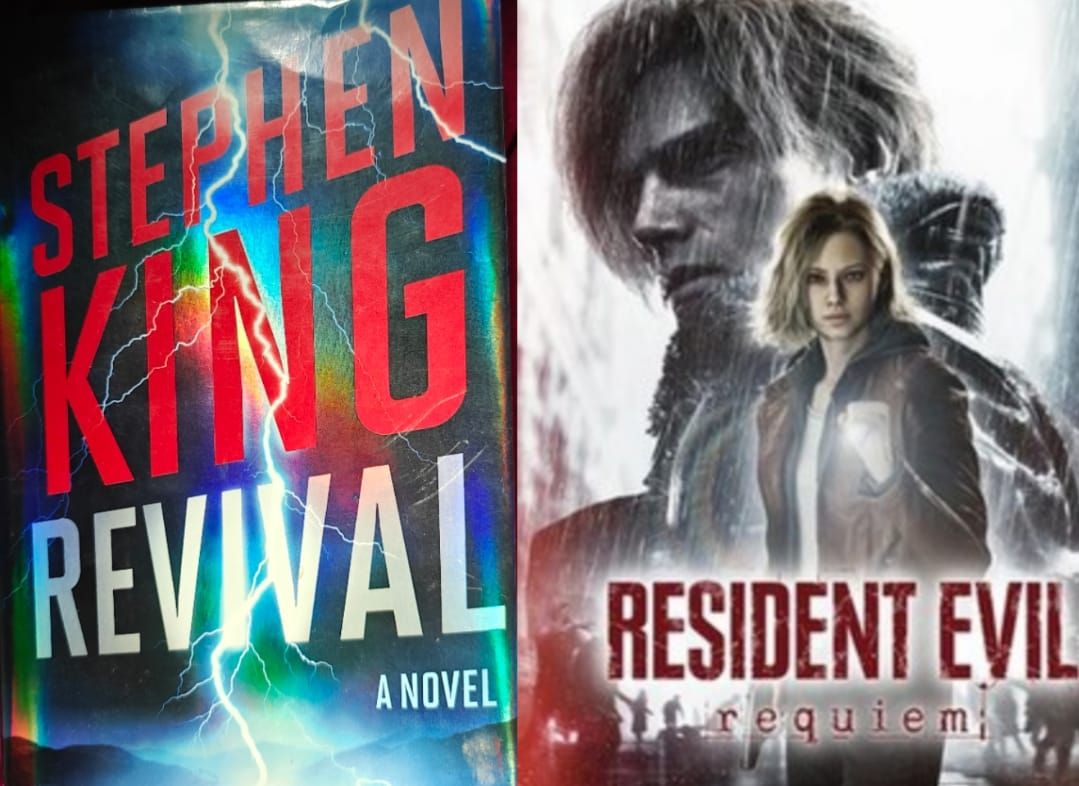
I was trying to come up with what to type up this week; a week in which I am feeling particularly uninspired, and wondered if I'd ever written about my feelings about the Resident Evil games, the latest of which I just finished. It turns out I had, in the same newsletter as I'd mused on re-reading Stephen King's Revival, a book I coincidentally finished re-reading again last week in anticipation of this month's new installment of Just King Things, which discusses it. In 2017 I had this to say about Revival:
[The book] takes a long time to get going, but really takes off once it does, offering one of the creepiest, bleakest resolutions of any of his works.
All of which is still true, but I have come to really enjoy the long build-up to the ending, which still hits like a freight train every time I read it. King is widely derided as being bad at ending books, but having read and re-read a lot of his stuff recently, I think this is more a a result of it being very difficult to satisfactorily tie-up a very long book with a conventional ending. There's a reason my favorite final line of a novel belongs to Elmore Leonard in Get Shorty:
Fuckin endings, man. They weren't as easy as they looked.
Anyway, Revival also has an all-timer ending, and the latest re-read drove home the fact that its bleakness wouldn't hit as hard without the slow build of the rest of the book.
You know what doesn't have a satisfying ending? Resident Evil: Requiem, the latest mainline entry in the three decade-old series about the perils of trying to bioengineer a mutant race of weaponized monsters in an advanced laboratory beneath a gothic mansion. Or gothic police station. Or gothic generic Old World village. Or...you get the idea.
In the same 2017 newsletter I wrote this about Resident Evil:
Resident Evil games tend to lean on splatter more than problem-solving, though they do offer a fair number of puzzles, too. Silent Hill games—the good ones, at least—prioritize exploration and logic, with combat reserved only for when it can't be avoided. I generally prefer Silent Hill, since not only is its gameplay more my speed, but the chills and thrills it offers are usually story-dependent and have more weight than the "virus-laden zombie hordes" of Resident Evil.
This critique holds true of the lastest RE game as well, since it also devolves into an action-y slog in its back half, but the first four to five hours are truly terrific, and I'm happy I played it. Elsewhere in that newsletter, I lament the dearth of really scary and engaging horror games, and between the first halves of the last two Resident Evils and the truly bonkers masterpiece that is Alan Wake 2, we're eating much better in the 2020s than I posited we would.
This is such a weird time for games, as the economic realities that have come home to roost in all forms of mass media seem to be pummeling them particularly hard, and there's hardly a week that goes by without news of another studio closure or mass layoff event, combined with c-suite execs crowing about how gen AI will lower costs and expand horizons, but not in a way that will piss people off, as they seem to have wised up to the fact that most of their audience is not interested in what ChatGPT thinks they want to hear come out of an NPC's mouth. So they talk about using it in "internal development" with the assumption that the objections will be less vociferous if people think a creative human being polished it up before sending it out into the world.
Sorry, literally every one of these could become a screed against AI if I don't watch out. I just hate it so goddamn much. At any rate, Resident Evil 9 is a mixed bag for non-AI reasons, and while I liked enough of it to recommend it, I loathed enough of it to probably never replay it. Oh, and per my last newsletter: We got a new apartment, so my doom-and-gloom-y outlook is back to baseline, which is not great but probably not fatal. At least, not this week.